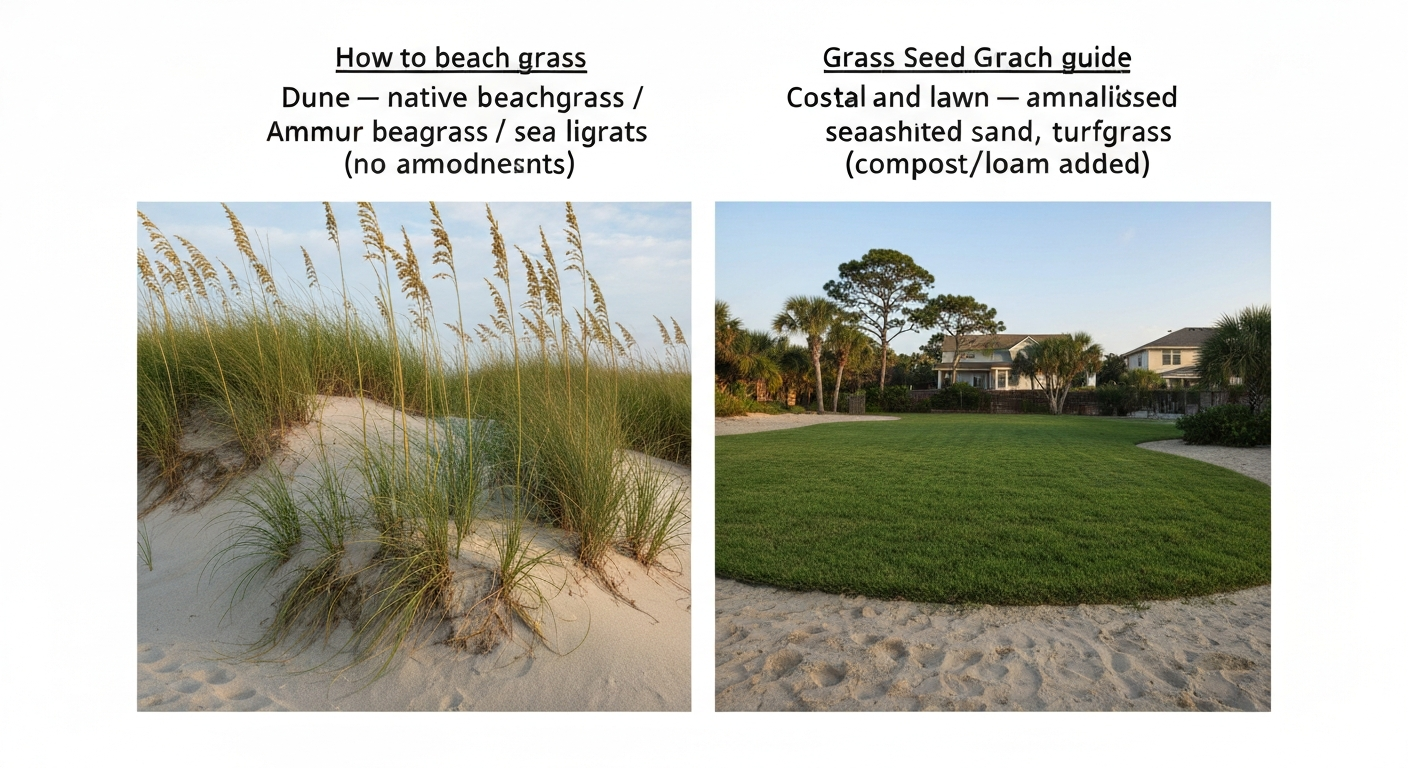
Beach grass is not one thing. If you want to stabilize a coastal dune and stop sand from migrating into your yard, you need native dune species like American beachgrass or sea oats planted as plugs at specific spacings. If you want a living lawn on sandy or coastal soil, you need a turf grass suited to salt exposure, sandy drainage, and your regional climate. Most people searching 'how to grow beach grass' need one or the other, and the planting methods, soil prep, and ongoing care are completely different. This guide covers both, with the exact species, amendment rates, seeding depths, and timelines you need to get it right the first time.
How to Grow Beach Grass: Sandy Soil, Dune vs Turf Guide
Marcus Tillwell
26 Jul 2026
Beach grass vs. turf grass: what each one actually does
True beach grasses are native dune-building plants. American beachgrass (Ammophila breviligulata) on Atlantic and Northeast coasts, and sea oats (Uniola paniculata) on Gulf and Southeast coasts including Florida, exist to trap windblown sand, build dune ridges, and protect shorelines. They grow in pure sand with no amendments, they do not form a mowable lawn, and they are often legally protected. You plant them as plugs or bare-root stock and leave them alone. They are not lawn grass.
Turf grasses for sandy or coastal lawns are a completely separate category. Bermudagrass, zoysiagrass, seashore paspalum, centipedegrass, and St. Augustinegrass are the warm-season options that handle sandy soil and salt exposure with varying degrees of tolerance. Tall fescue and perennial ryegrass are cool-season alternatives for transitional or northern coastal yards. These species can handle foot traffic, mowing, and pets. They need amended soil, irrigation, and fertilizer to establish and stay dense.
| Plant | Primary Use | Regions | Planted As | Mowable Lawn? |
|---|---|---|---|---|
| American beachgrass | Frontal dune stabilization | Atlantic/Northeast U.S. | Plugs/bare-root | No |
| Sea oats | Dune building, sand trapping | Gulf/Southeast U.S., Florida | Plugs/rhizome | No |
| Bitter panicgrass | Dune building, accretion | Gulf/Southeast U.S., Florida | Plugs | No |
| Saltmeadow cordgrass | Tidal shoreline stabilization | Atlantic/Gulf coast | Bare-root stock | No |
| Seashore paspalum | Coastal turf lawn | Southeast, Gulf, Hawaii | Sod/sprigs/seed | Yes |
| Bermudagrass | Sandy/coastal turf lawn | South, Southeast, Transition Zone | Seed/sod/sprigs | Yes |
| Zoysiagrass | Sandy/coastal turf lawn | Southeast, Transition Zone | Sod/plugs/seed | Yes |
| Centipedegrass | Low-input sandy turf | Southeast/Florida | Seed/plugs/sod | Yes |
| Tall fescue | Cool-season sandy lawn | Transition Zone, Mid-Atlantic coast | Seed | Yes |
| Perennial ryegrass | Cool-season sandy lawn / overseeding | Northern coast, Transition Zone | Seed | Yes |
Picking the right species for your site and goal
Dune stabilization
If you are on or near an active dune on the Atlantic coast from Maine to North Carolina, American beachgrass is your species. It thrives in nutrient-poor sand precisely because burial by windblown sand stimulates its growth. On the Gulf Coast and in Florida, sea oats is the dominant dune builder. UF/IFAS research also recommends bitter panicgrass (Panicum amarum) and gulf bluestem (Schizachyrium maritimum) as supplementary dune species in the Florida Panhandle. At tidal shorelines where you need to trap sand and initiate accretion, saltmeadow cordgrass (Spartina patens) planted as bare-root field stock is the standard choice. Always source locally grown, native-ecotype plants. Introducing non-local genetic stock can cause long-term ecological problems. Check with your state's coastal management office before planting dune species, since sea oats are protected in Florida and several other Gulf states.
Turf lawns on sandy and coastal soils
Salt tolerance is the first filter. If your yard is within a couple hundred feet of the ocean, receives direct salt spray, or floods occasionally with brackish water, seashore paspalum is the most salt-tolerant turf option available. Texas A&M/PlantAnswers documents that seashore paspalum (Paspalum vaginatum) ranks at or near the top of turf species for salinity resistance Texas A&M/PlantAnswers documents that seashore paspalum (Paspalum vaginatum) ranks at or near the top of turf species for salinity resistance.. It can handle soil electrical conductivity levels that would kill most common turf grasses. Bermudagrass and zoysiagrass have moderate salt tolerance and are good choices for most coastal sandy lawns from the Southeast through the Transition Zone. Centipedegrass is a solid low-input pick for Florida and the Deep South if salt exposure is limited. St. Augustinegrass is common in Florida but cultivar salt tolerance varies widely. For transitional or Mid-Atlantic coastal yards, tall fescue handles sandy soils well and tolerates modest salt exposure better than perennial ryegrass.
| Species | Salt Tolerance | Best Regions | Shade Tolerance | Traffic Tolerance |
|---|---|---|---|---|
| Seashore paspalum | Very high | Southeast, Gulf, Hawaii | Moderate | Moderate |
| Bermudagrass | Moderate | South, Southeast, Transition Zone | Low | High |
| Zoysiagrass | Moderate | Southeast, Transition Zone | Moderate | High |
| Centipedegrass | Low-moderate | Southeast/Florida | Low-moderate | Low |
| St. Augustinegrass | Variable by cultivar | Florida, Gulf Coast | High | Low-moderate |
| Tall fescue | Low-moderate | Transition Zone, Mid-Atlantic | Moderate | Moderate |
| Perennial ryegrass | Low | Northern coast, overseeding | Low-moderate | Moderate |
Assess your site before you buy anything
Spending 30 minutes measuring your site conditions will save you a season of failed establishment. Sand depth, drainage rate, salt exposure, and sun hours all determine which species will actually survive in your yard.
How to measure sand depth and drainage
Dig a hole about 18 inches deep in a representative spot in your yard. Note how deep the pure sand goes before hitting a different material, dense clay, compacted subsoil, or hardpan. If you hit clay within 6 to 8 inches, you have a mixed profile that will drain slowly and hold moisture unevenly. That clay pocket will behave differently from the sandy areas and often causes patchy establishment.
To test drainage, fill that same hole with water and watch it. If it drains completely in under 30 minutes, you have fast-draining sand that will require more frequent irrigation and leaches fertilizer quickly. If it holds water for several hours, you have either a compacted layer or a clay pocket slowing things down. In a mixed yard, do this test in two or three spots to map drainage variability.
Measuring salt risk
Salt spray damage decreases rapidly with distance from the shoreline and the presence of dunes or barriers. If you can smell ocean salt on windy days or see salt deposits on hard surfaces near your yard, your turf selection needs to account for spray. Yards within 100 to 200 feet of the water with no dune buffer between them and the shoreline should prioritize seashore paspalum or bermudagrass over centipede or cool-season species. If you are half a mile or more inland, salt spray is unlikely to be a limiting factor and your species decision can focus on soil type and climate.
Sun exposure
Count honest sun hours in your lawn area on a typical summer day. Bermudagrass needs at least 6 to 8 hours of direct sun and will thin badly under trees. Zoysiagrass and St. Augustinegrass handle partial shade (4 to 6 hours) better than bermuda. Tall fescue is the most shade-tolerant option for cool-season areas. If a section of your coastal yard gets fewer than 4 hours of sun, no warm-season grass will fill in well and you should consider ground covers or mulched beds instead.
Soil testing: what to measure and what ranges to target
A basic soil test from your county extension service costs $10 to $20 and tells you pH, organic matter percentage, phosphorus, potassium, and sometimes calcium and magnesium. For a coastal or sandy lawn, this is not optional, it tells you exactly what to add and how much, rather than guessing. Send a composite sample (about 10 to 15 small scoops from different spots in the planting area, mixed together) from the top 4 inches.
| Species | Target pH | Organic Matter Target | Key Notes |
|---|---|---|---|
| Bermudagrass | 6.0–7.0 | 2–3% minimum | Tolerates low fertility but rewards good prep |
| Zoysiagrass | 6.0–6.5 | 2–3% minimum | Sensitive to low pH on sandy soils |
| Centipedegrass | 5.0–6.0 | 2% minimum | Do NOT lime above 6.5; iron deficiency risk at high pH |
| Seashore paspalum | 6.0–7.5 | 2–3% minimum | Tolerates a range but responds well to organic matter |
| Tall fescue | 6.0–6.5 | 3–4% preferred | Needs higher OM to hold moisture on sand |
| Perennial ryegrass | 6.0–7.0 | 2–3% minimum | Germinates fast; OM helps on lean sandy soils |
| Sea oats / Am. beachgrass | No amendment needed | None added (pure sand preferred) | Do not add loam or compost to active dune areas |
If your soil test shows pH below the target range, add lime (calcitic or dolomitic) at the rate your extension report recommends. On sandy soils, small applications are more effective than one large dose because the low buffering capacity of sand means pH can swing more than on clay or loam soils. The exception is centipedegrass, resist the urge to lime it anywhere near 7.0 or you will cause iron-deficiency chlorosis that turns the lawn yellow.
What to add to sandy soil to grow grass
Pure sand has two problems: it holds almost no water and it holds almost no nutrients. You need to increase both before seeding or laying sod. For a step-by-step walkthrough on how to grow grass in sandy soil, see our detailed guide on how to grow grass in sandy soil. The two tools for this are compost (which builds organic matter fast and improves both water retention and nutrient holding) and loam (which adds silt and clay particles that give sand more structure). For detailed, step-by-step guidance on what to add to sandy soil to grow grass (compost vs. loam and exact amendment rates), see the related guide. In most residential sandy lawns, compost is the first priority. Loam is added when sand depth is so extreme that compost alone cannot compensate.
Compost amendment rates
To meaningfully raise organic matter in the top 4 to 6 inches of sandy soil, you need to add roughly 2 to 4 inches of finished compost before tilling. At a 3-inch application depth over 1,000 square feet, you need about 9.3 cubic yards of compost. At 2 inches, that drops to about 6.2 cubic yards per 1,000 square feet. Use finished compost, not raw wood chips or unfinished material. Till or rake the compost into the top 4 to 6 inches of the existing sand so it blends into the planting zone rather than sitting on top as a separate layer.
Loam addition
If your sand is deep (12 inches or more of pure sand with no clay or organic matter) and you want to grow turfgrass, adding a 2 to 4 inch layer of loam mixed into the top 6 inches gives the sand a meaningful structural upgrade. For details on how much loam to grow grass on sandy sites, the guideline is to add 2–4 inches mixed into the top 6 inches to give the root zone meaningful structure. At 2 inches of loam over 1,000 square feet, you need approximately 6.2 cubic yards. At 4 inches, that is about 12.3 cubic yards. Do not simply dump loam on top and seed over it, the interface between a loam layer and the underlying sand can create a perched water table and cause root problems. Mix it in. A rear-tine tiller set to 6 inches works well here. If you are working on a Florida sandy lawn or any site with very deep sand, a practical starting target is 2 inches of compost plus 2 inches of loam, both tilled into the existing surface sand to create a blended 6-inch planting layer.
| Amendment | Depth Applied | Cubic Yards per 1,000 ft² | Primary Benefit |
|---|---|---|---|
| Finished compost | 2 inches | 6.2 cu yd | Organic matter, water retention, nutrients |
| Finished compost | 3 inches | 9.3 cu yd | Greater OM boost for very lean sand |
| Loam | 2 inches | 6.2 cu yd | Soil structure, silt/clay fraction |
| Loam | 4 inches | 12.3 cu yd | Deep structural improvement on pure sand |
| Compost + loam (combined) | 2" each, tilled to 6" | ~12.4 cu yd total | Balanced improvement for sandy turf establishment |
One note for dune areas: do not apply loam or compost to active frontal dunes or dune-building zones. Native dune grasses like American beachgrass and sea oats are adapted to pure sand and do not benefit from amendments. Topsoil additions on active dunes can actually disrupt sand transport dynamics and harm native plant establishment. Save the amendment work for your residential lawn area behind the dune.
Preparing the planting bed on sand or mixed soils
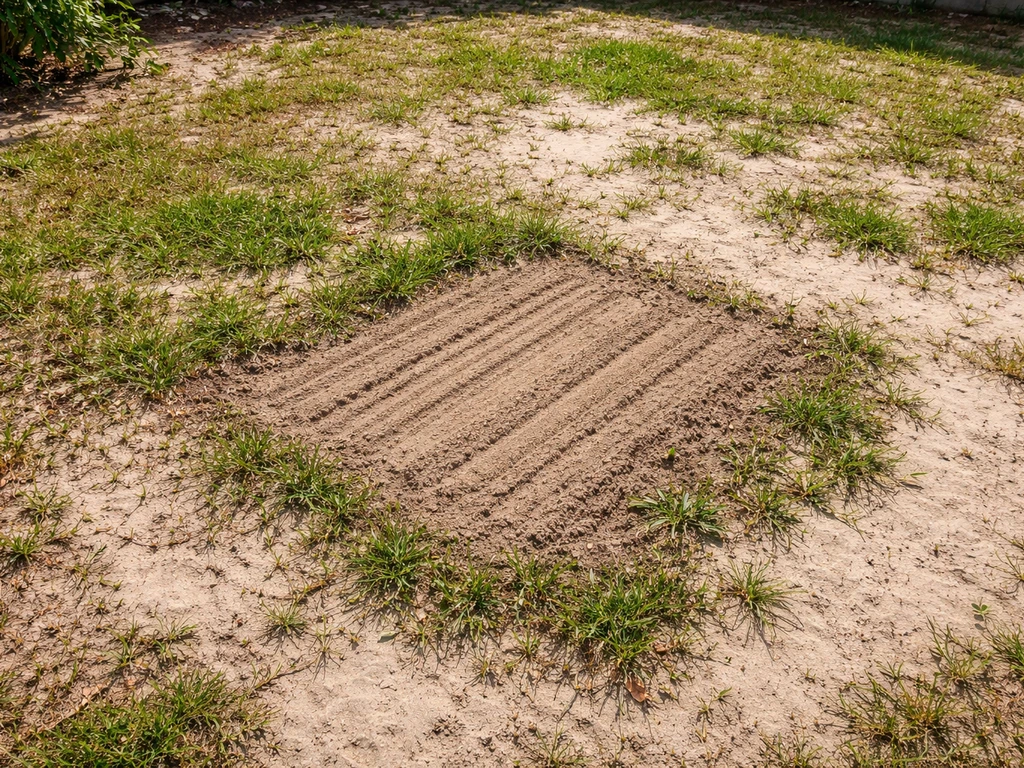
Good bed prep is where most DIY seeding jobs fail. The goal is a firm, level seedbed with 4 to 6 inches of amended, workable soil, not loose fluff, but not compacted either. Work on your bed when the soil is moist but not wet.
- Clear the area of all debris: rocks, roots, old sod, and any weeds. On sandy soils weeds pull easily, but take the time to get the roots. Anything left behind will compete aggressively with new seedlings.
- If you have clay pockets, break them up with a tiller or a heavy garden fork. Clay lenses in sandy soil act like bathtubs — water pools above them and roots stop growing. Till those spots extra thoroughly and blend in additional compost to improve drainage.
- Spread your compost (and loam if using) evenly across the surface at the depths calculated above.
- Till the entire bed to a depth of 4 to 6 inches using a rear-tine tiller. Make two passes in perpendicular directions to fully incorporate amendments.
- Rake the surface smooth and remove any remaining debris. Fill in any low spots — water will pool there after rain and kill seedlings.
- Firm the bed lightly with a lawn roller filled one-third with water, or simply walk across it systematically. You want the surface firm enough that your footprint sinks no more than half an inch. Loose, fluffy sand is actually bad for seed-to-soil contact.
- Wait 2 to 3 days before seeding to let any disturbed weed seeds germinate so you can kill them with a shallow cultivation pass — but do not wait so long the surface crusts over on hot sandy soils.
Seeding step by step: rates, depth, and germination timelines
Timing is everything with seed. Warm-season grasses need soil temperatures above 65 to 70 degrees Fahrenheit to germinate reliably, in Florida and the Gulf Coast that means March through September, but peak establishment is April through June before summer heat and storm stress sets in. For step-by-step local tips on timing, seed selection, and bed preparation specific to Florida, see how to grow grass seed in Florida. Cool-season grasses like tall fescue and perennial ryegrass need soil temperatures in the 60 to 75 degree range, which means fall planting (late September through November) in most coastal transitional or Mid-Atlantic areas.
Seed rates, depth, and germination by species
| Species | Seeding Rate (lbs/1,000 ft²) | Seeding Depth | Soil Temp for Germination | Days to Germinate |
|---|---|---|---|---|
| Bermudagrass (hulled) | 1–2 lbs | 1/8–1/4 inch | 65–75°F minimum | 7–21 days |
| Zoysiagrass | 1–2 lbs | 1/8–1/4 inch | 65–75°F | 14–21 days (slow) |
| Centipedegrass | 0.25–0.5 lbs (4–8 oz) | 1/8 inch max | 70–75°F | 14–28 days |
| Seashore paspalum | 1–2 lbs | 1/8–1/4 inch | 65–75°F | 10–20 days |
| Tall fescue | 6–8 lbs (new lawn) | 1/4–1/2 inch | 60–75°F | 7–14 days |
| Perennial ryegrass | 6–9 lbs (new lawn) | 1/4–1/2 inch | 50–65°F | 5–10 days |
| Sea oats (seed) | Not typical for homeowners — plugs preferred | Surface, light cover | Warm (70°F+) | Variable, often 3–6 weeks |
Centipedegrass seed is tiny, we are talking roughly the size of a grain of fine sand. For step-by-step guidance on seeding rates, soil amendments, and irrigation specific to centipedegrass on sandy soils, see how to grow centipede grass in sandy soil. Mix it with dry builder's sand at about 4 parts sand to 1 part seed before spreading so you can see where you have been and get even coverage. The same trick works for any very small-seeded grass. After spreading, do not bury centipede seed deeper than an eighth of an inch. Just a light rake-over or a pass with a drag mat is enough. Pressing it too deep is the most common reason centipede seeding fails.
After seeding, apply a light straw mulch at about 50 to 80 pounds per 1,000 square feet. This is not enough straw to smother germination, it should be thin enough that you can still see the soil surface through it. The mulch keeps moisture in and reduces surface erosion from wind or rain, both of which are serious problems on sandy coastal soils. On any slope or exposed area, use an erosion-control blanket instead of loose straw, which will blow away.
Irrigation during germination
Keep the top inch of soil consistently moist until germination is complete and seedlings are at least 1 inch tall. On sandy coastal soils in summer that typically means watering two to three times per day for 5 to 10 minutes each, applying about a quarter inch per watering session. Sandy soil dries out fast, especially if the wind is blowing. One dry afternoon can kill an entire germination flush. After seedlings reach 1 to 2 inches tall, shift to once-daily deep watering and then to a normal schedule once the lawn is mowed for the first time.
Plugs, sprigs, and vegetative planting
Vegetative planting (plugs and sprigs) is often smarter than seed on sandy soils, especially for slow-establishing species like zoysiagrass or when you want faster cover. Plugs give you a head start over seed and are more forgiving of the uneven moisture that sandy soils create during germination. The tradeoff is cost, plugs and sod cost more than seed.
Plug spacing and timing for turf species
For centipedegrass and zoysiagrass, plant 2-inch plugs on 6-inch centers. You will need roughly 100 to 150 plugs per 1,000 square feet. For bermudagrass and St. Augustinegrass, 2-inch plugs on 12-inch centers work (approximately 30 to 50 square feet of donor sod cut into plugs per 1,000 square feet). Plant plugs at the same depth they were growing, making sure the crown is at or just above the soil surface. Press firmly around each plug to eliminate air pockets, in sandy soil plugs can dry out from below if there are voids under them.
Best timing for warm-season plugs in most regions is late spring through early summer, when soil temperatures are above 70 degrees Fahrenheit and you still have the full growing season ahead for the grass to spread and fill in. In Florida, plugs can go in as early as March. Avoid planting plugs in August or September when heat stress is highest, they will survive but they will barely spread before the season ends.
When to choose plugs over seed
- Zoysiagrass — seed is slow and expensive; plugs establish a full season faster
- St. Augustinegrass — no viable commercial seed; plugs or sod are your only options
- Any area with significant slope or erosion risk where seeds will wash away before germination
- When you need faster cover for a high-traffic or pet area
- When seeding windows have passed and you still want to establish warm-season turf
Planting dune grass plugs: sea oats and American beachgrass
Dune grass planting is very different from turf plug work. For American beachgrass on Atlantic foredunes, blank" rel="noopener noreferrer">USDA NRCS specifications call for planting 2 culms per hole in an 8-inch-deep hole, with holes spaced about 18 inches apart in both directions. The root crown should sit at or just below the sand surface. Deeper is better than shallower, shallowing encourages burial tolerance which is how this plant spreads. For large projects, a powered auger mounted on a small tractor is used to achieve consistent depth without damaging roots, but for a homeowner planting a few hundred feet of dune face, a sturdy dibble bar or crowbar works fine.
For sea oats in Florida and the Gulf Coast, UF/IFAS dune restoration guidance recommends planting in a staggered pattern with the seaward rows at wider spacing (around 36 inches) and progressively tighter spacing inland (18 then 12 inches) as the dune builds. Spring planting gives the best survival. An important technique from UF/IFAS research: applying a thin layer of surrogate wrack (wheat straw about 8 inches deep, loosely placed around newly planted sea oats) significantly improves plant vigor, promotes earlier flowering, and accelerates sand accumulation. It mimics the natural seaweed and organic material that accumulates around dune plants in the wild. This is one of those details that makes a real difference in a restoration planting.
Watering and fertilizing during establishment and after
Establishment phase irrigation
Newly laid sod needs at least two watering sessions per day delivering about a quarter inch each until the sod is firmly rooted, typically 2 to 3 weeks. You can check by tugging at a corner of the sod; once it resists lifting it has rooted. For plugs, water daily for the first 2 weeks, then taper to every other day as roots establish. On sandy soils in summer heat, morning and late-afternoon watering during the first week prevents wilting, which can permanently set back plug establishment.
Once established, target about 1 inch of total water per week (rain plus irrigation). On sandy soil, the smarter approach is to split this into two or three applications per week, roughly half an inch every 3 days, rather than one deep weekly watering. The reason is that sandy soil holds about half an inch of plant-available water per inch of soil depth, so a heavy weekly application mostly leaches past the root zone. Shorter, more frequent runs keep water where roots can reach it.
Fertilizing on sandy soils
Sandy soils leach nitrogen fast. Use slow-release nitrogen sources (polymer-coated urea, ESCO-type products, or organic fertilizers) for the majority of your fertilizer program. Limit quick-release nitrogen to no more than 0.25 to 0.5 pounds of actual N per 1,000 square feet per application on sandy soils. Applying more than that at once is mostly a waste, it leaches before roots can use it and can cause fertilizer burn on stressed seedlings.
Annual nitrogen targets vary by species. Bermudagrass on a home lawn typically needs 2 to 4 pounds of actual N per 1,000 square feet per year split across the growing season. Centipedegrass is a low-input grass, in Florida, UF/IFAS guidance recommends 0.5 to 1 pound of N per 1,000 square feet per application (lower with quick-release products, higher with slow-release), with a maximum of 2 pounds total per year. More nitrogen on centipede causes thatch buildup and makes it more vulnerable to disease. Zoysiagrass falls in the middle at roughly 2 to 3 pounds per year for a sandy coastal lawn. Wait until 4 to 6 weeks after germination or plugging before applying any nitrogen to new plantings, you want roots established first.
Troubleshooting bare spots, erosion, salt damage, and shade
Bare spots and patchy germination
If you are getting patchy germination on a seeded sandy lawn, the most common causes are uneven moisture (dry pockets where sandy soil dries faster than surrounding areas), seed buried too deep, or seed that washed or blew into low spots. Scratch the surface gently in a bare spot after 3 weeks, if you see small sprouts barely starting, you had a delay, not a failure. If you see nothing, re-seed those areas after loosening the surface. Add a thin layer of compost as a top-dressing over bare patches before reseeding to help retain moisture.
Erosion control while waiting for cover
Sandy soils erode fast from wind and rain. Before your new lawn establishes, protect slopes and any exposed sandy areas with biodegradable erosion control blankets staked into the ground. These are inexpensive at most hardware stores and decompose on their own as grass grows through them. On flat areas, the straw mulch applied over seed does double duty as erosion control. If you have an active erosion problem on a coastal site, consider planting dune grass species or cordgrass in the affected zone before attempting turf establishment behind it.
Salt spray damage
Salt spray shows up as leaf tip burn starting on the windward side of the lawn and progressing inward. If you see this pattern, consider switching to a more tolerant species at the next renovation, and rinse the lawn with fresh water after severe storms or extended periods of onshore wind. If you have a sprinkler system, running it briefly after a big storm to wash salt off leaf surfaces can prevent prolonged damage. For long-term solutions on high-exposure sites, seashore paspalum is genuinely your best bet. No amount of care makes a salt-sensitive grass survive direct ocean exposure reliably.
Shade and pet damage
In shaded sections of a coastal yard, bermudagrass will thin out and die under tree canopies. Switching to St. Augustinegrass or zoysiagrass in those spots, or transitioning to a shade-tolerant ground cover, is a more sustainable solution than repeatedly seeding bermuda into shade. For pet damage, which usually shows up as dead or discolored patches from urine nitrogen burn, the fastest fix on sandy soils is to flush the spots with water immediately after use (the high drainage rate actually helps here), and reseed or replug those areas as needed in the appropriate season.
Ongoing care and when to overseed or call a pro
Once your lawn or dune planting is established, maintenance on sandy coastal soil is mostly about irrigation consistency and conservative fertilizing. Avoid the temptation to push warm-season turf with heavy nitrogen in late summer or fall, it stimulates soft growth that is less tolerant of winter cold, which matters even in Florida during occasional cold snaps.
Overseeding a warm-season coastal lawn with perennial ryegrass in fall (once soil temperatures drop below 70 degrees Fahrenheit) keeps the lawn green through winter in the transition zone and parts of Florida. For localized tips specific to Florida's climate and turf choices, see our guide on how to grow grass in Florida. Use 5 to 7 pounds of perennial ryegrass seed per 1,000 square feet and scalp the existing warm-season turf to half an inch before seeding so the ryegrass makes good soil contact. The ryegrass will fade out naturally when warm-season turf comes back in spring.
Call a coastal landscape professional if: you have active shoreline erosion threatening your property, you are dealing with legal requirements for permitted dune restoration, you suspect nematode damage (common in Florida sandy lawns and causes persistent thinning that looks like drought stress), or your soil test shows severe pH or nutrient problems that simple amendments have not resolved. For the routine stuff, seeding, plugging, amending sandy soil, and managing irrigation, this is very doable as a DIY project with the right information and a realistic timeline.
FAQ
What is the difference between “beach/dune” beach grass and turf grasses for sandy lawns?
True dune or "beach" grasses (e.g., American beachgrass Ammophila breviligulata on Atlantic coasts; sea oats Uniola paniculata, bitter panicgrass Panicum amarum, gulf bluestem Schizachyrium maritimum in the Gulf/Southeast) are native, salt‑tolerant, rhizomatous plants selected to trap windblown sand and build foredunes. They are planted on dynamic, active dunes and should not receive heavy loam/topsoil. Turf grasses (Bermuda, Zoysia, Centipede, St. Augustine, tall fescue, ryegrass, seashore paspalum) are managed for a lawn appearance, need a smoother surface and more root zone material; they are planted in yards, not on the seaward dune-front. Choose dune species for erosion control near the shore; choose turf species for recreational lawns inland of the dune/vegetation line.
Which species should I choose for coastal dunes vs. a sandy Florida lawn?
Coastal dune front (stabilization): Atlantic/Northeast — American beachgrass (Ammophila breviligulata); Gulf/Southeast/Florida — sea oats (Uniola paniculata), bitter panicgrass (Panicum amarum), gulf bluestem, beach elder. Tidal flats/low marsh edges — cordgrasses/spartina species or Sporobolus spp. Sandy Florida lawns: warm-season turf — Bermudagrass (good for wear), Zoysiagrass (dense, slower), Centipedegrass (low‑input, prefers sandy, acidic soils), St. Augustine (shade tolerant cultivars), Seashore paspalum (best salt tolerance). For salted/spray-exposed yards choose seashore paspalum or tolerant Bermudas/Zoysias; avoid cool‑season grasses on very salty exposed sites.
How and when should I plant dune beach grasses (spacing, depth, timing)?
Use locally sourced native stock where possible. Best practice is spring or early summer for most coastal species. Planting method: hand-planted plugs or bare‑root clumps. Example specs (USDA/NRCS & UF/IFAS): American beachgrass — place 2 culms per planting hole in an ~8‑inch deep hole, spacing 18–24 inches between plants and between rows; sea oats/bitter panicgrass — plugs/hand‑sets often spaced 12–36 inches in staggered rows (seaward rows wider, e.g., 36" seaward, 18" middle, 12" inland). Position the crown at or just below the sand surface. Use mechanical augers for large projects. Do NOT add heavy loam on active foredunes — leaving or adding surrogate wrack (straw ~6–8" layer) can increase sand trapping and establishment.
What planting methods work for turf on sandy soils (seed, plugs, sod, sprigs) and when to use each?
Seed — lowest cost for species with available seed (Bermuda, Centipede, Bahiagrass, rye/fescue mixes); use when large areas and budget constrained. Plugs/sprigs — good for Centipede, Zoysia, St. Augustine (via sod plugs), and Bermudagrass sprigs when seed isn’t available or where faster cover vs. seed is desired; spacing per UF/IFAS tables (e.g., Centipede/Zoysia 2" plugs at ~6" centers for aggressive fill; Bermudagrass/St. Augustine plugs 12" centers). Sod — fastest result, immediate cover; best for slopes/erosion-prone spots but costliest. Vegetative (rhizome) — useful for Bermuda/other sod-forming grasses when turf quality or cultivar fidelity required. Choose seed for cost, plugs/sod for speed/erosion control.
Exact seeding rates, plug counts, and spacing examples for common turf species (per 1,000 sq ft)
Centipedegrass seed: 0.25–1 lb/1,000 sq ft (some UF sources list ~4 oz/1,000 for broadcast — check seed purity). Bermudagrass seed: 1–4 lb/1,000 sq ft. Bahiagrass: 5–10 lb/1,000 sq ft. Plug example counts: 2" plugs at 6" centers (approx. 100–150 plugs per 1,000 sq ft depending on plug size and spacing) for Zoysia/Centipede; 2" plugs at 12" centers for St. Augustine/Bermuda (roughly 30–50 plugs per 1,000 sq ft). Sod equivalence: 1,000 sq ft requires ~1,000 sq ft of sod (cutting into plugs increases plugs per sod area). Always consult the seed/sod supplier for cultivar-specific rates.
How should I assess a sandy site (soil profile, compaction, clay pockets, salinity)?
1) Dig several 6–12" test holes across the site to evaluate sand depth and presence of clay pockets. 2) Check for hardpan/compaction with a screwdriver or a soil probe. 3) Send a composite soil sample (top 4–6") to your local extension for texture, pH and EC (salinity) testing. 4) Observe drainage and wind/salt exposure. Decision points: if sand is >12" deep and uniform you can build lawns with minimal loam additions; if clay pockets exist, remove or mix them into top 6–8" and add loam to create a consistent root zone. If EC (soil salinity) is elevated, choose salt‑tolerant species (seashore paspalum, tolerant Bermudas) and expect reduced performance for sensitive species.
Next Article
How to Grow Grass in Sandy Florida Soil Step by Step
Step-by-step guide to grow Florida grass in sandy soil, fixing low nutrients, drainage, seeding, watering, and bare spot