In Minnesota, the single best thing you can do for a new lawn is seed between mid-August and mid-September. That window gives cool-season grasses the warm soil they need to germinate quickly, plus weeks of mild weather to root before winter arrives. Miss that window and your next best option is early spring, as soon as the ground is workable and soil temps at 2 inches hit around 45–50°F. Everything else, which seed to buy, how deep to plant it, how often to water, follows from getting that timing right first.
How to Grow Grass in Minnesota: Complete Seed-to-Lawn Guide

Marcus Tillwell
30 Jul 2026
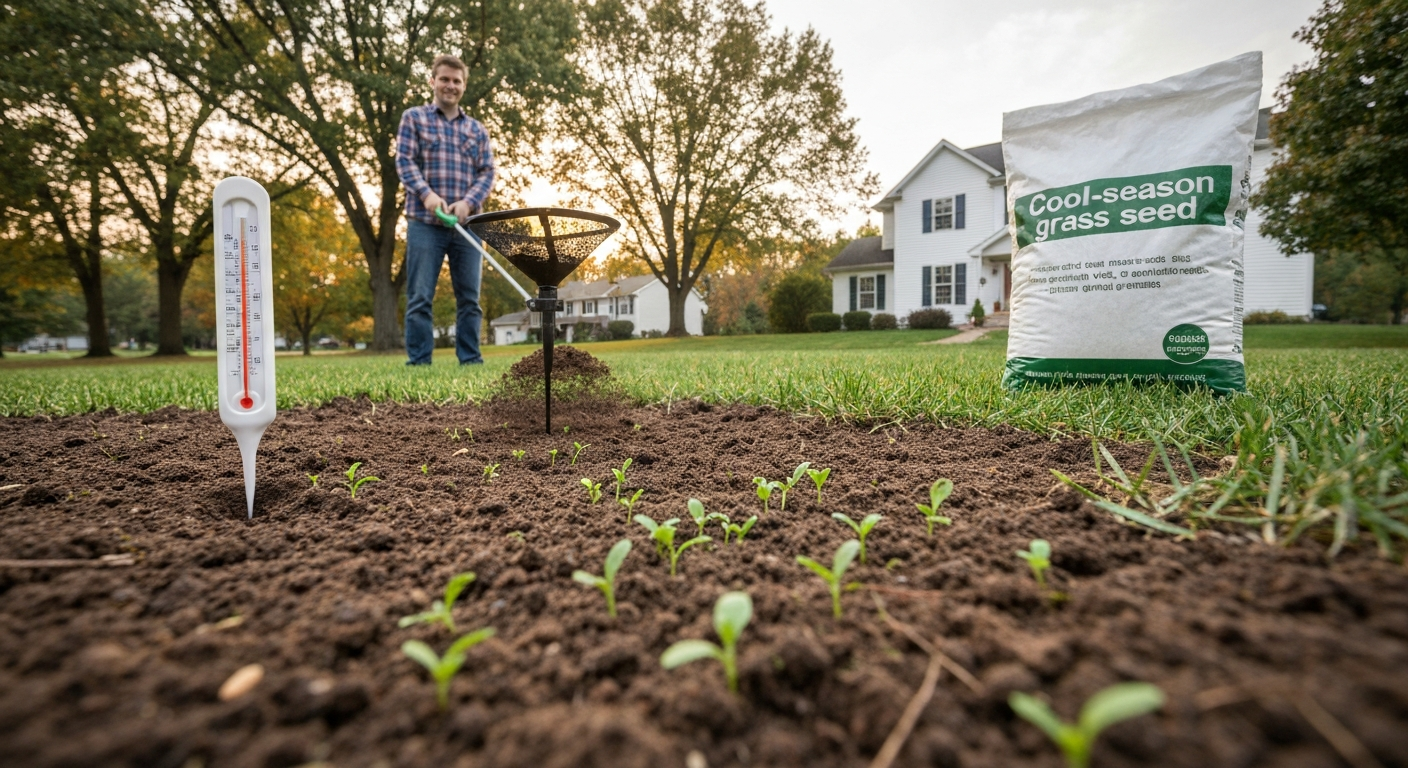
What this guide covers for Minnesota homeowners
Minnesota lawns face a specific set of challenges that generic lawn guides just don't address: brutal winters, short growing seasons, heavy clay soils in the Twin Cities metro, sandy soils further north, and shade from mature trees in older neighborhoods. This guide walks through everything in sequence, climate zones, seed variety selection, exact seed mixes, seeding rates, germination timelines, soil prep, watering, mowing, fertilizing, and troubleshooting. Whether you're starting from bare dirt, overseeding thin spots, or trying to repair pet damage, there's a specific section for each scenario.
Minnesota's lawn climate: what to expect by region
Minnesota spans USDA hardiness zones 3b to 5b, which translates to winters that can drop well below zero in the north and more moderate (but still harsh) conditions in the south. The Twin Cities metro sits in zone 4b–5a. For lawn purposes, the practical divide is between southern Minnesota (longer growing season, more reliable fall seeding windows) and northern Minnesota (shorter season, higher risk of early frost cutting into fall establishment time).
Soil type varies sharply by region. The Twin Cities and surrounding suburbs are dominated by heavy clay soils that compact easily, drain slowly, and get waterlogged in spring. Once you move into the Minnesota River valley, the St. Cloud area, and especially the northern and western parts of the state, you start hitting sandy loam and pure sand that dries out fast and needs more frequent watering during establishment. Both extremes benefit from soil testing before you seed, more on that below.
Rainfall averages around 25–30 inches per year statewide, but it comes unevenly. Hot, dry July and August stretches are common and can stress newly seeded lawns if you seed too late in summer. That's exactly why late summer (mid-August onward) is the sweet spot: soil is still warm from summer, but air temps are dropping, reducing the stress on young seedlings and slowing weed competition.
Seed, sod, or hire a pro: a quick decision checklist
Most Minnesota homeowners can handle a seeding or overseeding project themselves. Sod and professional installation make sense in specific situations. Here's how to decide:
- Seed if: you have time to water daily for 3–4 weeks, your yard is more than 1,000 sq ft, and you're okay waiting one full season for a mature lawn. Seeding is the most affordable option and gives you access to the widest variety selection.
- Seed if: you're overseeding thin areas, filling bare spots, or renovating a lawn that still has 50% or more desirable grass.
- Sod if: you need instant coverage for erosion control on a slope, you have a small high-traffic area (under 500 sq ft), or you're installing a yard before a hard deadline (new construction, home sale). Sod costs roughly 5–10x more than seed per square foot.
- Sod if: you have pets or kids who won't stay off the lawn long enough for seedlings to establish (sod is usable in about 2–3 weeks vs. 8–10 weeks for seed).
- Hire a pro if: your yard needs significant grading or drainage work before seeding, you're dealing with a severe erosion problem on steep slopes, or you're renovating more than 5,000 sq ft and don't have equipment access.
- Hire a pro if: your soil test reveals major pH or nutrient problems that require large-scale amendment before seeding.
Best timing to plant grass in Minnesota
The fall window (mid-August to mid-September)
University of Minnesota Extension is clear on this: mid-August to mid-September is the preferred seeding window. Soil temperatures are still in the 60–70°F range from summer warmth, which is ideal for germination. Weed pressure drops significantly compared to spring and summer. And seedlings have 6–8 weeks to root before the ground freezes, which is enough time to build the cold-hardiness they need to survive a Minnesota winter. If you're in northern Minnesota (Duluth, Bemidji, International Falls), aim for early-to-mid August to get ahead of earlier frost dates.
Spring seeding (early April to mid-May)
Spring seeding works, but it's the second-best option. The main challenges are: the ground needs to be workable (not frozen or saturated), soil temps need to hit at least 45–50°F at 2 inches depth, and you're racing against crabgrass germination. If you apply pre-emergent herbicide for crabgrass control in spring, you can't seed at the same time, the herbicide prevents grass seed germination too. So spring seeders typically skip pre-emergent and accept some crabgrass pressure in year one, which can be managed by mowing and crowding out. Spring-seeded Kentucky bluegrass lawns in particular can struggle through their first summer heat, so keep watering consistent.
What about dormant seeding?
Dormant seeding (broadcasting seed in late November or early December, after the ground freezes) is a low-effort option some Minnesota gardeners use for problem areas. The seed sits in the soil over winter and germinates in early spring when temps rise. Results are variable, seed can wash away or be eaten by birds, but for bare slopes or hard-to-water areas, it's worth trying as a supplemental approach rather than a primary seeding strategy.
Warm-season grasses in Minnesota: the honest answer
Bermudagrass and zoysia are not realistic options for most of Minnesota. Both are warm-season grasses that go dormant below about 55°F and can be killed outright by Minnesota winters in zones 3b–5a. Even in the warmest part of the state (southern Minnesota near Iowa), winter kill is a serious risk with these species, and they won't perform or look good during Minnesota's long cool-season months. If you're curious about warm-season varieties and live in a warmer state, the guides for growing grass in Oklahoma or Tennessee are more relevant to those species. For detailed advice on warm-season species and regional practices, see how to grow grass in Tennessee. For practical guidance on warm-season species and regional practices, see the guide on how to grow grass in Oklahoma. For region-specific advice on warm-season species and Utah's climate, see how to grow grass in Utah. For guidance tailored to very cold, short‑season climates, see how to grow grass in Alaska. For guidance on warm-season grasses and establishment in a southern climate, see how to grow grass in Alabama. For warm‑season guidance in the Southeast, see how to grow grass in Georgia.
The one partial exception is zoysia in the most protected microclimates of extreme southeastern Minnesota (near La Crescent or the Iowa border) with extra winter protection, but even then it's an experiment, not a reliable lawn plan. Stick to cool-season grasses for Minnesota. They're the right tool for the climate.
Best grass varieties for Minnesota lawns
Minnesota lawns are cool-season territory, and you have four main species to work with. Understanding what each one does well, and where it struggles, helps you build a mix that performs across seasons and conditions.
Kentucky bluegrass
Kentucky bluegrass is the gold standard for sunny Minnesota lawns. It produces a dense, attractive turf with good cold hardiness and the ability to self-repair through rhizomes (underground runners). The catch is that it's slow, germination takes 10–30 days, and a new seeding won't look fully established until its second season. It's also higher maintenance: it needs more water, more fertilizer, and more mowing attention than fescues. University of Minnesota turfgrass trials track cultivar performance specifically for Minnesota winter hardiness and disease resistance, so checking the most recent UMN trial results before buying is worth the 10 minutes.
Perennial ryegrass
Perennial ryegrass is the fast germinator in any mix, it sprouts in as little as 3–10 days and establishes quickly, which makes it useful as a companion species with slower bluegrass. It's good for high-traffic areas and has decent wear tolerance. In Minnesota, perennial ryegrass can winterkill in harsh years, especially in zones 3b–4a. For that reason, UMN Extension generally recommends using it as a minority component in mixes (20–30%) rather than a standalone lawn.
Tall fescue
Tall fescue is more drought-tolerant and heat-tolerant than bluegrass, with deeper roots that help it survive dry Minnesota summers without constant irrigation. It does well in clay soils because its roots can penetrate compacted layers. Modern turf-type tall fescue cultivars are much finer-textured than older varieties and blend reasonably well in a mixed lawn. It's a solid choice for low-to-moderate maintenance lawns in southern Minnesota. In the north, it may winterkill in severe cold snaps.
Fine fescue (creeping red, hard, sheep, chewings)
Fine fescues are the workhorses for shade and low-input Minnesota lawns. They're the most shade-tolerant cool-season grasses available, they require less fertilizer and water than bluegrass, and they're the foundation of no-mow and low-mow lawn mixes. UMN turfgrass research specifically on fine fescue seeding rates and no-mow stand longevity shows that using adequate Pure Live Seed (PLS) rates improves how well no-mow stands persist over time. UMN turf trials report that higher Pure Live Seed (PLS) seeding rates improve longevity of no‑mow fine fescue stands (The Effect of Fine Fescue Species and Seeding Rate in No‑Mow Areas, Turfgrass Science, Univ. of Minnesota) blank" rel="noopener noreferrer">The Effect of Fine Fescue Species and Seeding Rate in No‑Mow Areas — Turfgrass Science, Univ. of Minnesota. For shady areas under trees, a very common Minnesota challenge, fine fescues are nearly always the right answer.
Seed mixes for common Minnesota lawn goals
Most Minnesota lawns perform better with a blend than a single species. Blends spread risk across species so that if one type struggles in a particular year, others fill in. Here are practical formulas based on UMN Extension recommendations:
| Lawn Goal | Recommended Mix | Notes |
|---|---|---|
| Sunny, low-input | 50–60% common Kentucky bluegrass + 40–50% fine fescue | Good choice for homeowners who want a decent-looking lawn without heavy fertilizer or irrigation investment |
| Sunny, high-input | 70–80% improved Kentucky bluegrass + 20–30% perennial ryegrass | Best appearance and density; requires more water, fertilizer, and mowing. Use UMN-trialed cultivars. |
| Shady, low-input | 80–100% fine fescues + 0–20% Kentucky bluegrass | Fine fescue handles the shade; remove bluegrass entirely in deep shade (under dense conifers) |
| Shady, moderate-input | 60% fine fescue + 25% improved Kentucky bluegrass + 15% perennial ryegrass | For dappled or part-shade areas with some direct sun |
| Low-mow/no-mow | 100% fine fescue blend (creeping red + hard fescue + sheep fescue) | Designed for minimal maintenance; do not add bluegrass or ryegrass, which require mowing |
| High-traffic/durability | 40% Kentucky bluegrass + 40% tall fescue + 20% perennial ryegrass | Good for play areas, dog runs, and heavily used yards |
| Erosion control/slopes | 40% tall fescue + 40% perennial ryegrass + 20% fine fescue | Fast germination (rye) stabilizes soil while fescue establishes a durable stand |
Seeding rates, depth, and germination timelines
How deep to plant grass seed in Minnesota
This is one of the most common seeding mistakes: burying seed too deep. Cool-season grass seed should be incorporated into only the top 1/4 inch of soil. No deeper than 1/2 inch, beyond that, seedlings run out of energy before they reach the surface and you get poor, patchy germination. The practical method is to rake the seed lightly after broadcasting, then roll with a lawn roller (most rental shops have them) to press seed into firm contact with the soil. You're not burying it; you're just making sure there are no air gaps between seed and soil.
For overseeding thin lawns, the best approach is to core-aerate first (or rent a slit-seeder), then broadcast seed. The cores and slits give seed direct soil contact without any raking needed. Overseed at roughly half the new-lawn seeding rate, overseeding is supplementing existing turf, not starting from scratch.
Seeding rates and germination reference table
| Grass Type | New Lawn Rate (lb/1,000 sq ft) | Overseeding Rate (lb/1,000 sq ft) | Seeding Depth | Germination (days) | Optimal Soil Temp |
|---|---|---|---|---|---|
| Kentucky bluegrass | 1–3 | 0.5–1.5 | 1/4 inch or less | 10–30 days | 50–65°F |
| Perennial ryegrass | 3–5 | 1.5–2.5 | 1/4 inch | 3–10 days | 50–65°F |
| Tall fescue (turf-type) | 6–9 | 3–4.5 | 1/4–1/2 inch | 7–14 days | 50–65°F |
| Fine fescue | 3–5 | 1.5–2.5 | 1/4 inch or less | 7–14 days | 45–65°F |
| KY bluegrass/rye blend | 3–4 | 1.5–2 | 1/4 inch | 3–14 days (rye first) | 50–65°F |
A note on germination days: these are ranges under good conditions, meaning adequate moisture, correct soil temps, and quality seed with good germination rates. Kentucky bluegrass at the slow end of that 10–30 day range is normal, don't assume failure and reseed after two weeks. Keep the surface moist and give it the full window before evaluating.
How to apply seed evenly
Split your total seed amount in half. Apply the first half walking in one direction across the lawn, then apply the second half walking perpendicular to your first pass. This cross-hatch pattern dramatically reduces thin strips caused by spreader overlap or misses. For large areas, a drop spreader or rotary spreader works well. For small patches or bare spots, mix seed 1-to-4 by volume with a natural organic fertilizer or compost, it makes the thin seed visible as you spread by hand and adds organic matter to the patch at the same time.
Soil testing and amendments: clay, sand, and everything in between
Sending a soil sample to the University of Minnesota Soil Testing Laboratory before you seed is genuinely worth doing. The test costs around $20–25 and tells you pH, phosphorus, potassium, and organic matter levels, plus specific fertilizer recommendations for your soil. Collect 12–15 subsamples from across your yard (use a trowel or soil probe to about 4 inches deep), mix them together in a bucket, and submit about 2 cups of the composite sample with the lab's request form. Results take about two weeks. Your local county extension office can supply sample bags and forms.
Clay soil (common in Twin Cities metro)
Heavy clay drains slowly and compacts under foot traffic, but it holds nutrients well and can actually support a beautiful lawn once it's managed correctly. Before seeding, core-aerate the entire area, a single pass isn't enough on truly compacted clay, so do two passes in perpendicular directions. Topdress with 1/4 to 1/2 inch of compost after aerating and work it into the cores. This won't transform clay into loam overnight, but done consistently over 2–3 seasons it meaningfully improves structure. Avoid tilling compost deeply into clay, it can create a hardpan layer at the till line. For pH, most Minnesota clay soils run slightly alkaline; if your test shows pH above 7.5, sulfur applications can help bring it down toward the 6.0–7.0 sweet spot for cool-season grasses.
Sandy soil (northern and western Minnesota)
Sandy soils drain too fast, which means they dry out quickly and don't hold nutrients well. Before seeding, incorporate 2–4 inches of compost into the top 6 inches of sandy soil, this is the one situation where tilling makes sense, because you're actually changing the soil's physical structure. Plan to water more frequently during establishment than you would on heavier soils. Once established, lawns on sandy soil benefit from more frequent, lighter fertilizer applications (using slow-release products) since nutrients leach through faster.
Growing grass in the shade
Shade is one of the most frustrating lawn challenges in Minnesota, especially in older neighborhoods with large oaks, maples, and elms. The honest truth is that no grass thrives in dense, full shade, if you have less than 3–4 hours of direct or filtered sunlight per day, consider ground covers, mulch, or a shade-tolerant perennial bed instead of fighting a losing battle with grass. But for moderate shade (4–6 hours), fine fescues are your best tool.
- Use a mix of 80–100% fine fescues (creeping red fescue, hard fescue, chewings fescue) for shaded areas. These are the most shade-tolerant cool-season grasses available.
- Raise your mowing height to 3.5–4 inches in shaded areas. More blade surface means more photosynthesis in low light.
- Reduce nitrogen fertilizer under trees — shade-grown grass needs less N than sunny lawn, and over-fertilizing leads to disease.
- Rake or blow tree leaves off promptly in fall. A mat of wet leaves kills fine fescue seedlings fast.
- Prune lower tree branches if possible to increase light penetration — even removing one branch per tree can meaningfully improve grass vigor underneath.
- Expect to overseed shady areas annually. Root competition from trees and reduced light mean these areas thin out faster than sunny sections.
Pet-friendly lawn strategies
Dog urine burns are a real and recurring problem, and there's no grass variety that's completely immune to nitrogen overload from concentrated urine. The most effective approach is dilution: train dogs to use a specific area of the yard if possible, and water the area immediately after they urinate to flush the nitrogen through the soil. For repair, perennial ryegrass and tall fescue are the fastest to re-establish in burned spots, broadcast seed at new-lawn rates directly into bare patches, rake lightly, keep moist, and expect coverage in 10–14 days.
For high-traffic dog run areas, a mix weighted toward tall fescue (40–50%) and perennial ryegrass (30–40%) holds up to wear better than pure bluegrass lawns. Kentucky bluegrass does self-repair through rhizomes, but it's slow, in a heavily trafficked dog area it can't keep up. Keep traffic off newly seeded patches for at least 4–6 weeks to allow roots to anchor.
Step-by-step seeding process
- Test your soil first. Send samples to the UMN Soil Testing Lab or a certified private lab. Results take about two weeks, so plan ahead.
- Kill or remove existing weeds and unwanted vegetation. For a full renovation, glyphosate applications 2–3 weeks before seeding are common; rake out dead material after it browns.
- Address any grading issues. The final grade should slope away from your foundation at roughly 1–2% slope. Fill low spots that hold water.
- Amend soil based on test results. Add lime to raise pH, sulfur to lower it, compost to improve structure on both clay and sandy soils.
- If core-aerating (recommended for clay or compacted soils), do it now, before seeding.
- Apply starter fertilizer at the recommended rate from your soil test, or use a generic starter (high in phosphorus, e.g., 10-20-10) at label rates.
- Calibrate your spreader and apply seed using the cross-hatch method: half the seed in one direction, other half perpendicular.
- Rake very lightly to get seed into the top 1/4 inch of soil surface. Do not bury seed deeper than 1/2 inch.
- Roll the area with a water-filled lawn roller to ensure firm seed-to-soil contact.
- Water immediately — wet the top 1/2 inch of soil. Begin the daily light-watering schedule described below.
Watering schedule: germination through establishment
Getting the watering right during germination is where most first-time seeders fail. Too little and seed dries out and dies. Too much and you get fungal issues and seed wash. Here's how to break it into phases:
| Phase | Timing | Watering Goal | Frequency |
|---|---|---|---|
| Germination | Day 1 through first sprouts (varies by species) | Keep top 1/2 inch of soil consistently moist — never let it dry out and crust over | 2–3 times daily in hot/dry weather; 1–2 times in cool cloudy weather |
| Early seedling | First sprouts through 2-inch height (weeks 2–4) | Maintain surface moisture, begin transitioning to slightly deeper watering | Once daily, or twice if soil dries quickly (sandy soils or hot days) |
| Establishment | After first mowing through 8 weeks | Encourage deep rooting — water deeply and less frequently | Every 2–3 days, applying 1/2 inch per session |
| Mature lawn (first full season) | After 8 weeks | 1–1.5 inches per week total (rain + irrigation) | 2x per week deep watering, or adjust based on rainfall |
In practical terms: during the first two weeks after seeding, you may need to water three times a day in warm, sunny, breezy conditions. This is annoying but critical. A soaker hose or oscillating sprinkler on a timer makes it manageable. The surface should look dark and damp, not puddling. Once you see seedlings clearly sprouting, you can start backing off the frequency and increasing the duration of each watering session.
First-season mowing and fertilizing
When and how to mow new seedlings
Start mowing when seedlings reach about 2 inches tall. Kansas State University turf guidance (Establishment Methods and Timing, Kansas State Univ. Turf) recommends beginning mowing when seedlings reach about 2 inches, following the 'one‑third rule' (remove no more than one‑third of blade height per mow), and limiting heavy traffic on first‑season seedlings to avoid compaction and damage Establishment Methods and Timing — Kansas State Univ. Turf. Use the one-third rule: never remove more than one-third of the blade height in a single mow. For most cool-season grasses at 2 inches, that means cutting to about 1.5 inches, but honestly, set your mower to its highest setting (typically 3.5–4 inches) and mow when grass reaches 5–5.5 inches. This is gentler on young roots. Make sure your mower blades are sharp; dull blades tear seedlings out of loose soil. Keep heavy traffic, lawn furniture, kids, dogs, off the area until after the third or fourth mow.
Fertilizing new grass
Apply about 1/2 lb of actual nitrogen per 1,000 sq ft when seedlings reach 2 inches tall (roughly timed with your first mow). This is typically your starter fertilizer application. After the first mowing, switch to a slow-release nitrogen source rather than quick-release synthetic fertilizer, which can burn young roots. In the first season, the goal is root establishment, not lush top growth, so don't over-fertilize. A second light application of slow-release N in late September (for fall-seeded lawns) or early June (for spring-seeded lawns) is usually sufficient for the first year.
Common weed and disease problems
Crabgrass is the most aggressive weed competition for new Minnesota lawns. If you seed in fall (mid-August to mid-September), crabgrass is already past its peak germination period, which is one of the big advantages of fall seeding. Spring seeders will see crabgrass pressure, mow consistently at 3.5–4 inches once the lawn is established to shade out crabgrass seedlings, and accept that year one may have some. You can treat crabgrass selectively with post-emergent herbicides once the lawn has been mowed three times (check product labels for new lawn restrictions).
Pythium blight and dollar spot are the most common fungal diseases in Minnesota lawns. Both thrive in warm, humid conditions with poor air circulation, exactly what you get in heavily watered new seedlings during warm fall periods. The best prevention is to water in the morning so the surface dries before evening, avoid overwatering, and maintain good air circulation by not seeding too densely. If you see circular brown patches in new seedlings (Pythium) or small bleached spots (dollar spot), back off watering frequency slightly and improve airflow. Most new lawn fungal issues resolve as the lawn matures and you transition to deeper, less frequent watering.
Troubleshooting: bare spots, slow germination, and other common problems
Seed didn't germinate after 3 weeks
Check which species you planted. Kentucky bluegrass legitimately takes 10–30 days and the slow end is common in cooler conditions. If you planted a blend, you should see perennial ryegrass sprouts within 10 days, if there's nothing at all after two weeks, dig up a small patch and look for seed: if it's rotted (brown and mushy), you had too much moisture; if it's intact and unchanged, it dried out before germinating. In either case, reseed the area, correct the watering issue, and make sure soil temps are still above 45°F.
Persistent bare spots
Recurring bare spots that resist seeding are usually a symptom of an underlying problem: excessive shade, compaction, poor drainage, or dog traffic. Identify the cause first. If it's compaction, core-aerate aggressively before reseeding. If it's shade, switch to a fine fescue blend and raise mowing height. If it's drainage (water pools there after rain), you either need to regrade or install a French drain before any seeding will stick. Erosion on slopes can be managed by seeding perennial ryegrass first (fastest germination to anchor soil), then overseeding with a permanent mix later in the season.
Thin, patchy lawn after the first season
If your lawn looks thin heading into its second year, overseeding in late August is the fix. Core-aerate the whole lawn, overseed at half the new-lawn seeding rate using your original blend, and water through germination. This is normal maintenance for Minnesota lawns, especially those with Kentucky bluegrass which fills in slowly through rhizomes. By the third season of consistent overseeding and proper fertilizing, most thin lawns become dense enough to crowd out weeds on their own.
Sod installation basics for Minnesota
If you're going the sod route, the same soil prep principles apply: test, amend, grade, and firm the soil before laying. Order sod from a local supplier (Minnesota sod farms typically grow Kentucky bluegrass or KY-blue blends suited to local conditions). Lay sod within 24 hours of delivery, it dries out fast in summer heat. Stagger seams like brickwork, press edges firmly together, and roll after laying. Water daily for the first two weeks until sod is rooted (test by gently tugging a corner, resistance means roots have knit into the soil). Avoid heavy foot traffic for at least 3 weeks.
Minnesota lawn resources worth bookmarking
University of Minnesota Extension is the most reliable free resource for Minnesota-specific lawn guidance. Their lawn renovation guide (updated 2024) covers the core seeding protocols, and their turfgrass science program publishes annual cultivar trial data that helps you choose between specific Kentucky bluegrass, perennial ryegrass, and fescue varieties that have been tested under Minnesota conditions. The UMN Soil Testing Laboratory accepts samples year-round and is the most cost-effective soil testing option in the state. Your local county extension office is also a practical first stop, many offer soil sample bags, local plant hardiness information, and referrals to certified lawn care professionals if you decide to hire out part of the project.
If you're comparing Minnesota's approach to other northern climates, the challenges here share some similarities with growing grass in Colorado (cold winters, variable precipitation) and in Alaska (extremely short seasons), though Minnesota's longer growing season and higher humidity give you more flexibility than either of those states. The core principle across all of them is the same: match your timing and species to your actual local conditions, and don't shortcut the soil prep.
FAQ
When is the best time to seed a lawn in Minnesota and what are spring options?
Best time: mid‑August to mid‑September (prime window for soil warmth, moisture and reduced weed pressure). Spring option: early spring as soon as soil is workable and soil temps at 2" are near/above ~45–50°F—accept slower initial growth and higher weed competition. Avoid summer (heat/stress) and very late fall when seedlings won’t get established before freeze.
Which grass species and varieties are recommended for Minnesota lawns?
Prefer cool‑season grasses. Common recommendations: - Kentucky bluegrass (improved cultivars from UMN trials) — good for high‑quality, wear tolerant lawns but slower to establish. - Perennial ryegrass — fast germination and establishment; often used in mixes for quick cover. - Tall fescue (modern blends) — deeper roots, drought/traffic tolerant. - Fine fescues (creeping red, chewings, hard) — best for shade and low‑input sites. Use locally trialed cultivars where possible (see UMN Turf cultivar lists). Warm‑season grasses (bermuda, zoysia) are generally not recommended for most of Minnesota except limited southern exposures and with strong winter protection/acceptance of dormancy.
What seed mixes and seeding rates should I use (including overseeding rates)?
Typical new‑lawn seeding rates per 1,000 ft² (bulk seed, adjust for PLS as needed): - Kentucky bluegrass: 1–3 lb - Perennial ryegrass: 3–5 lb - Tall fescue (blend): 6–9 lb - Fine fescues: 3–5 lb Example mixes: - High‑quality sunny lawn: 60% improved KY‑blue + 40% perennial ryegrass — total 3–4 lb/1,000 ft². - Low‑input sunny: 50–60% common KY‑blue + 40–50% fine fescue — 3–5 lb/1,000 ft². - Shady/low‑input: 80–100% fine fescues — 3–5 lb/1,000 ft². Overseeding: about 50% of new‑lawn rates (e.g., if new‑lawn rye rate is 4 lb/1,000 ft², overseed with ~2 lb/1,000 ft²). For small bare spots, use seed-to-fill mixes and follow label PLS adjustments.
How deep should I plant seed and what seeding technique works best?
Seed depth: keep burial very shallow — incorporate into the upper ~1/4 inch of soil; avoid deeper than ~1/2 inch. Technique: loosen soil, apply seed in two passes (half in one direction, half perpendicular), rake or drag lightly to mix, roll or tamp for seed‑to‑soil contact. For overseeding, core‑aerate or slit‑seed for best contact. Use drop or rotary spreaders for uniform coverage in larger areas.
What are typical germination timelines by species under good conditions?
Approximate germination (days) under favorable moisture and temp: - Perennial ryegrass: 3–10 days - Tall fescue: 7–14 days - Fine fescues: 7–14 days - Kentucky bluegrass: 10–30 days Keep the surface consistently moist during these windows; full turf cover may take several months for blends with KY‑blue.
How should I prepare soil and what soil tests/amendments are needed for clay or sandy soils?
Soil test: collect 12–15 subsamples for a large yard (fewer for small areas), mix and submit ~2 cups to UMN Soil Testing Lab or county extension. Tests return pH, P, K, OM and fertilizer recommendations. Amendments: - Clay soils: add organic matter (compost topdressing, 1/2–1" incorporated where renovating), improve drainage, consider gypsum only if recommended by test; avoid heavy tilling that worsens compaction — core‑aerate and add compost to cores. - Sandy soils: add compost to increase water and nutrient holding; incorporate slowly; prefer deeper‑rooting tall fescue blends for drought tolerance. Adjust pH per test (lime or sulfur) before seeding when possible.
Next Article
How to Grow Grass in Alabama: Seed, Sod & Lawn Care Guide
How to grow grass in Alabama: step-by-step seeding, sod, soil tests, grass choices, and care by region.